



Student info - Magnonics
Information for Bachelor and Master students interested in magnonics.
Contact person: Michal Urbánek (group leader), michal.urbanek@ceitec.vutbr.cz
On this page:
Spin waves are collective excitations of magnetic moments in magnetic materials, with their quantized counterparts known as magnons. The field of magnonics, a sub-branch of spintronics, harnesses these waves for information processing. Because magnons propagate without charge transport, they do not generate Joule heat (characteristic of conventional electronics). This energy efficiency, combined with wavelengths scaling down to the nanometer range, positions spin waves as a promising candidate for beyond-CMOS technology. Furthermore, their intrinsic wave nature enables interference-based logic, while their accessible nonlinear dynamics open new pathways for neuromorphic and reservoir computing.
To see our focus, visit the Magnonics and magnetization dynamics page.
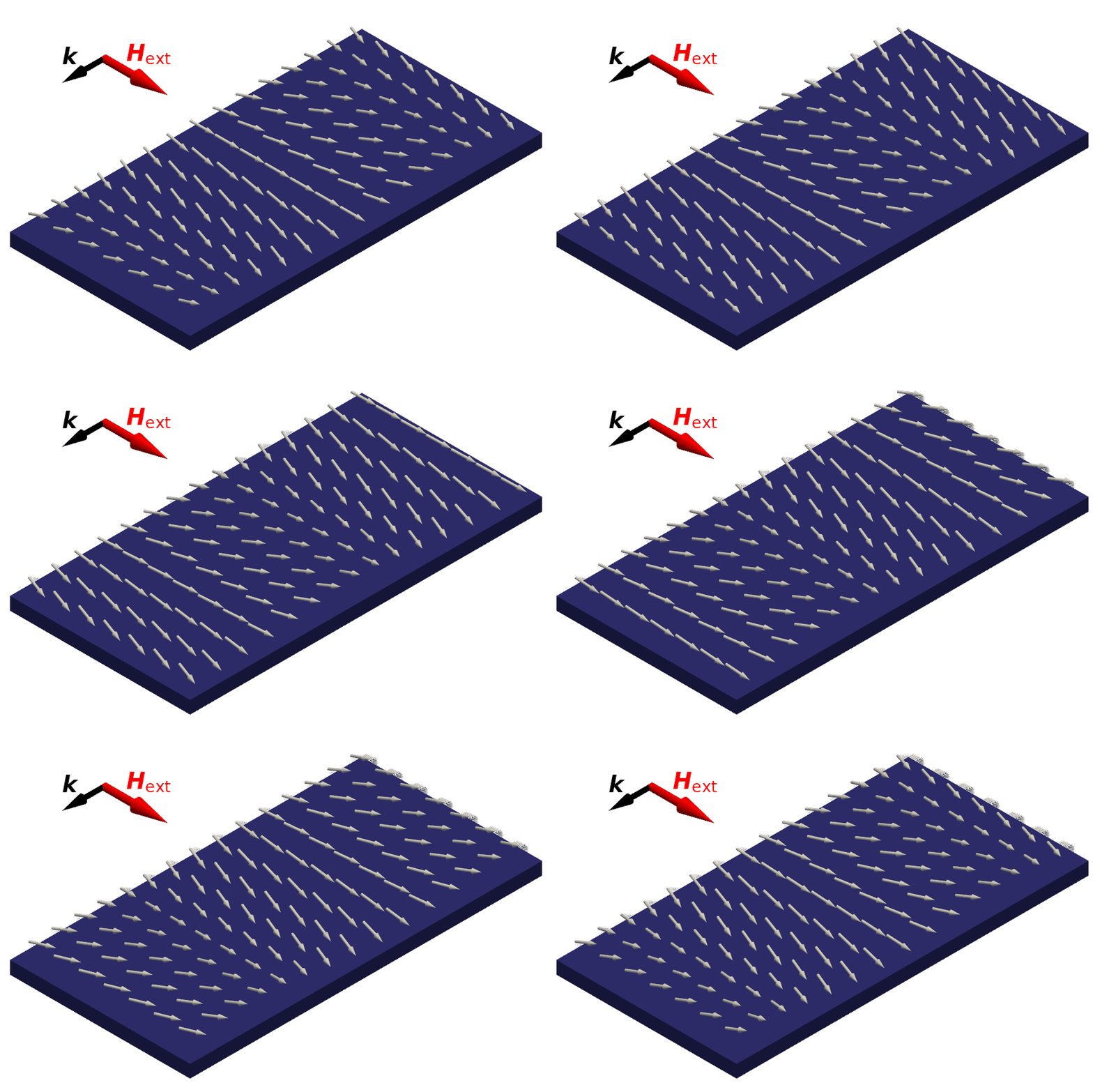
Illustration of a propagating spin wave in a ferro-magnet. Magnetic moments (gray arrows) precess around a common direction set by the external magnetic field Hext (red).
Further reading:
- Coey, John M. D. Magnetism and magnetic materials. Cambridge: Cambridge Univ. Press, 2010. ISBN 9780521816144.
- Stancil, Daniel D. and Prabhakar, Anil. Spin Waves: Theory and Applications. Boston, MA: Springer US, 2009. ISBN 9780387778648
- Chumak, Andrii V. MAGNONICS - Lecture series [online]. YouTube.com. Available from: https://youtube.com/playlist?list=PLdD_3zCk2ykbvol5n00djNOFqXJSzJReQ&si=8wRK9Lcz7Krj9KPU
Possible student activities
The following outlines the core research activities available to students within our group. These opportunities are not restricted to formal theses; we actively encourage semestral or summer research projects (subject to prior consultation with the group leader) tailored to student's individual interests.
We are seated in the CEITEC Nano RI, and therefore the students are usually provided access to all the self-service equipment related to their work.
- nanofabrication & nanocharacterization
Students engage in the complete nanofabrication lifecycle, including e-beam or optical lithography, etching, and deposition (by evaporation or sputtering) techniques. Typical lithography-made structures involve microwave antennas for spin-wave excitation/detection, photonic resonators, magnonic waveguides, etc. After appropriate training, students operate these high-end instruments independently.
Students also characterize the samples using, e.g., an electron microscope and atomic force microscope for topographic analysis, or more specific instruments, e.g., x-ray reflectometry for thickness measurements of thin films with sub-nanometer precision. - Brillouin light scattering (BLS) microscopy and spectroscopy
Our BLS instrument is a versatile tool for spin-wave measurements in the spatial and frequency domain. It was developed and is maintained exclusively by us, therefore students have the unique opportunity to get acquainted with it to the smallest details and perform further development and custom modifications. - electrical spin-wave spectroscopy
Measurements of material's magnetic properties and spin-wave propagation are the basis of magnonics. Students get hands-on experience with a vector network analyzer to measure magnetization dynamics and spin waves at the microwave frequencies (0.1–50 GHz). - magnetometry and magnetotransport
Common experiments include measurements of hysteresis loops either via vibrating sample magnetometry (VSM) or magneto-optical Kerr effect (MOKE). Extraction of saturation magnetization and magnetic anisotropy parameters is crucial part of magnetic material characterization. Our MOKE microscope is also capable of visualizing magnetic domains in thin films and microstructures. Furthermore, measurements of electric transport can be used to observe a plethora of effects where the sample's resistance changes with magnetic field/magnetization/spin currents. - superconductor fabrication and characterization
Students are able to grow thin superconducting films (by magnetron sputtering) and fully characterize their properties using electric transport measurements. - theory and simulations
Numerical and theoretical analyses of the experiments are an integral part of research. Students learn how to use the simulation software, analyze the data, and present the outcomes. We have experience with micromagnetic simulations using MuMax3 and MuMax+, photonic simulations using Ansys Optics (Lumerical), or the COMSOL Multiphysics simulation program. - software development
We are developing and maintaining a Python package called SpinWaveToolkit, which serves us as the main tool to perform quick calculations of the magnonic phenomena as well as BLS spectra simulations. Students contribute to its codebase, learning software versioning and packaging, as well as the theory behind the implemented models/functionalities.
Most activities require the students to have some programming experience (or be willing to learn). This is because the measured results may sometimes yield large amount of data, which is unnecessarily time-consuming to analyze by hand. We prefer Python, although MATLAB, LabVIEW, and other programming languages/frameworks are also welcome.
Available theses topics
The list of topics is not exhaustive. The final topic depends on the discussion with the group leader and individual needs of the student.
- Optimization of ferromagnetic thin film growth for applications in magnonics
The student would perform deposition and systematic characterization of selected materials, focusing on their magnetic properties in dependence to deposition parameters. The analysis would consist of, e.g., atomic force microscopy to get surface roughness/granularity, x-ray reflectometry to determine the thickness, (optionally low-energy electron diffraction to assess the crystallinity), and ferromagnetic resonance measurements to retrieve the magnetic properties of the layers. - Development of microwave-absorption measurement circuits
The student would perform a numerical study (in COMSOL Multiphysics) to design and optimize microwave printed circuit boards (PCBs) for magnonic applications. The PCBs will be fabricated by a commercial company according to the prepared designs and finished in-house. The finished PCBs would then be characterized for use in, e.g., ferromagnetic resonance measurements, propagating spin-wave spectroscopy, and magnetoresistance measurements. - Spin-wave detection using magnetoresistance
to be filled - Spin-wave excitation and detection via voltage-controlled magnetic anisotropy
to be filled - ...