



Magnonics and magnetization dynamics
Current research topics
BLS methodology
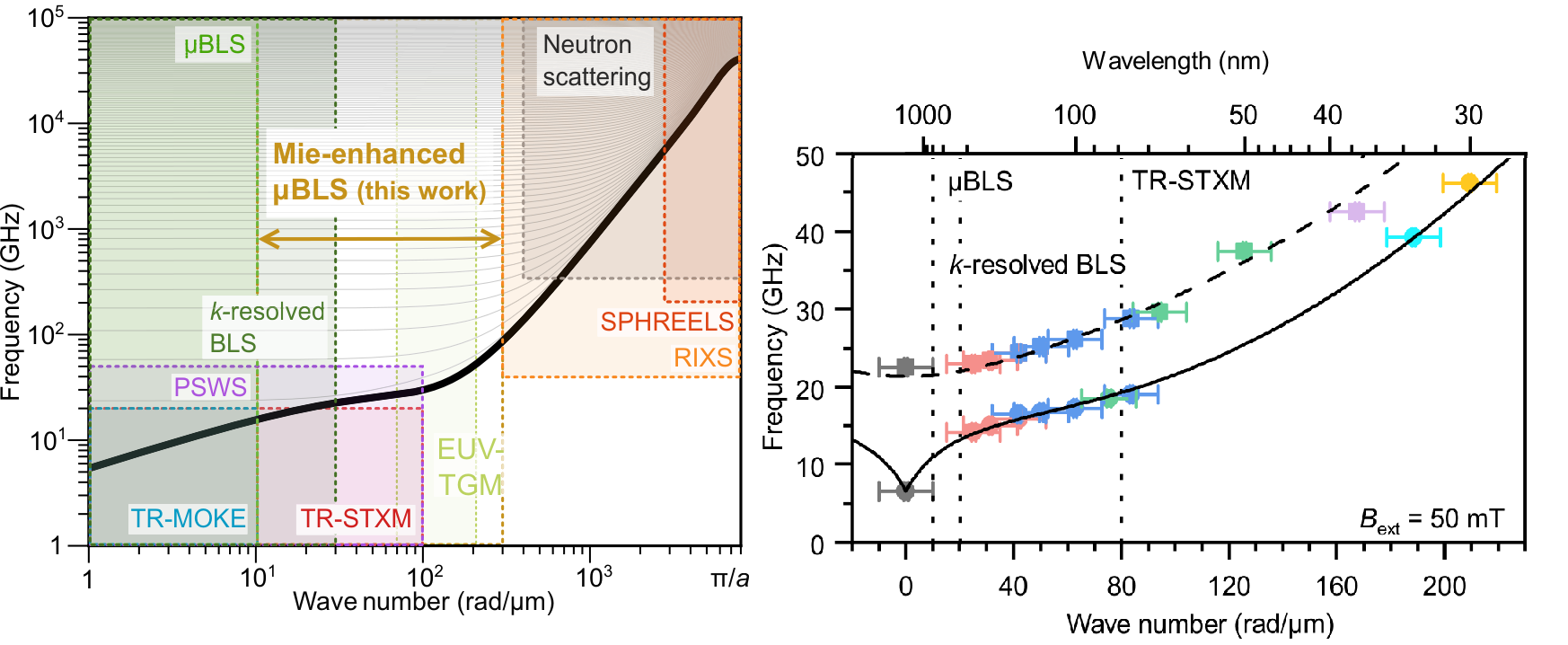
Brillouin light scattering (BLS) is an optical technique capable of studying magnetic (and acoustic) excitations in the 100–103 GHz range. The micro-focused (µ) BLS instrument developed in our group offers a wide variety of measurement modes, making it a “swiss knife” of spin-wave research.
We focus not only on the experimental part of the µBLS, but also on developing theoretical descriptions of the spin-wave BLS signal. Furthermore, the Mie-enhanced µBLS technique is actively studied here. Recently, we have demonstrated that this technique is capable of measuring spin waves with wavelengths as small as 30 nanometres.
Related publications:
- Krčma et al., Mie-enhanced microfocused Brillouin light scattering for full wave vector resolution of nanoscale spin waves, Science Advances 11, eady8833 (2025). DOI: 10.1126/sciadv.ady8833
- Wojewoda et al., Modeling of microfocused Brillouin light scattering spectra, Physical Review B 110, 224428 (2024). DOI: 10.1103/PhysRevB.110.224428
- Wojewoda et al., Phase-resolved optical characterization of nanoscale spin waves, Applied Physics Letters 122, 202405 (2023). DOI: 10.1063/5.0151338
- Wojewoda et al., Observing high-k magnons with Mie-resonance-enhanced Brillouin light scattering, Communication Physics 6, 94 (2023). DOI: 10.1038/s42005-023-01214-z
Magnonics with superconductors
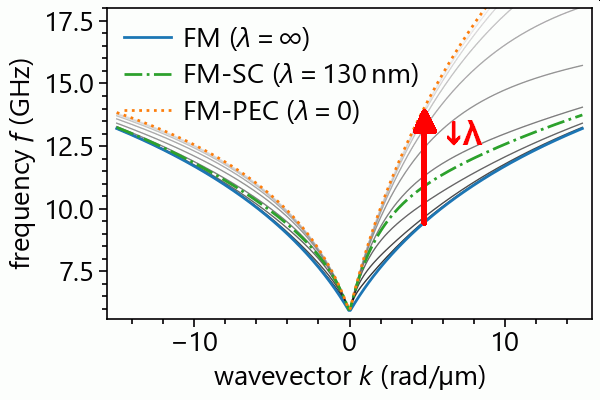
We study spin waves at low temperatures and their manipulation by superconducting elements. Superconductors can be used, e.g., to alter the spin-wave dispersion relation, create magnonic crystals and focusing elements, or increase the spin-wave excitation efficiency with superconducting antennas.
For measurements, we use a recently-developed cryo-VNA setup, capable of measuring microwave signals at temperatures down to 2 K (with 100 mK stability) and magnetic fields up to 9 T.
Magnonic materials and devices
Other projects related to magnonics.
Spin waves in synthetic antiferromagnets
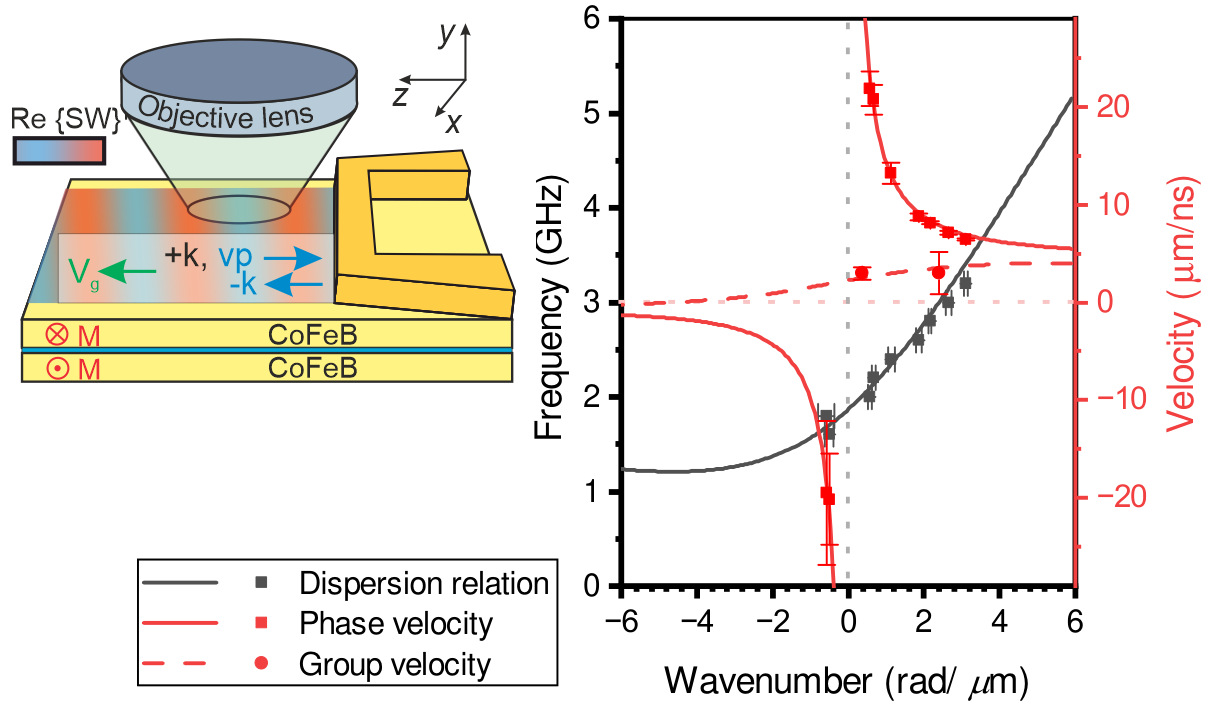
Interlayer exchange-coupled (IEC) multilayers, especially synthetic antiferromagnets (SAFs), are intensively studied for their easily-achievable non-reciprocal spin-wave properties. Our primary focus lies in the experimental manipulation of spin waves in such systems. Recently, we have reported on unidirectional zero-momentum magnons, a phenomenon where the group velocity preserves its direction while the phase velocity reverses near the Gamma point (k = 0). Magnons in SAFs can exhibit smooth, monotonous dispersion curves that facilitate unidirectional energy flow, offering significant potential for magnonic applications such as diodes and circulators.
Another research direction with SAFs is domain wall motion for magnetic racetrack memories, mainly studied in the group led by Vojtěch Uhlíř.
Related publications:
- Wojewoda et al., Unidirectional propagation of zero-momentum magnons, Applied Physics Letters 125, 132401 (2024). DOI: 10.1063/5.0218478
Metastable Iron - magnetic patterning by focused ion beam writing
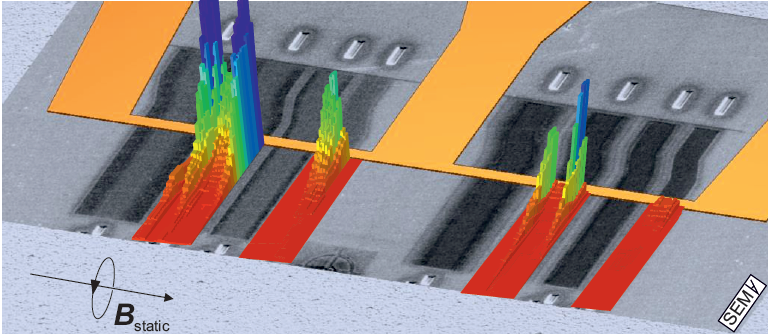
Direct writing of magnetic patterns by focused-ion-beam irradiation presents a favorable alternative to the conventional lithography approaches. We study epitaxially grown metastable face-centered cubic (fcc) Fe thin films which undergo structural (fcc->bcc) and magnetic (paramagnetic->ferromagnetic) phase transformation upon ion-beam-irradiation. By using focused ion beam (FIB) we are able to write ferromagnetic (bcc Fe) patterns into the paramagnetic (fcc Fe) layer with sub-100 nm resolution with control over the saturation magnetization (irradiation dose) and even anisotropy (irradiation scanning direction).
The transformed structures are ideal for building complex magnonic circuits and devices. Currently, the project runs in two branches, one branch is aimed to material development and the second branch focuses on magnonic application.
Related publications:
- Flajšman et al., Physical Review B 101(1), 014436 (2020). DOI: 10.1103/PhysRevB.101.014436. arXiv:1906.12254
- Gloss et al., Applied Surface Science 469, 747-752 (2019). DOI: 10.1016/j.apsusc.2018.10.263. arXiv:1807.08055
- Urbánek et al., APL Materials 6, 060701 (2018). DOI: 10.1063/1.5029367
- Gloss et al., Applied Physics Letters 103, 262405 (2013). DOI: 10.1063/1.4856775
Variable-gap propagating spin-wave spectroscopy
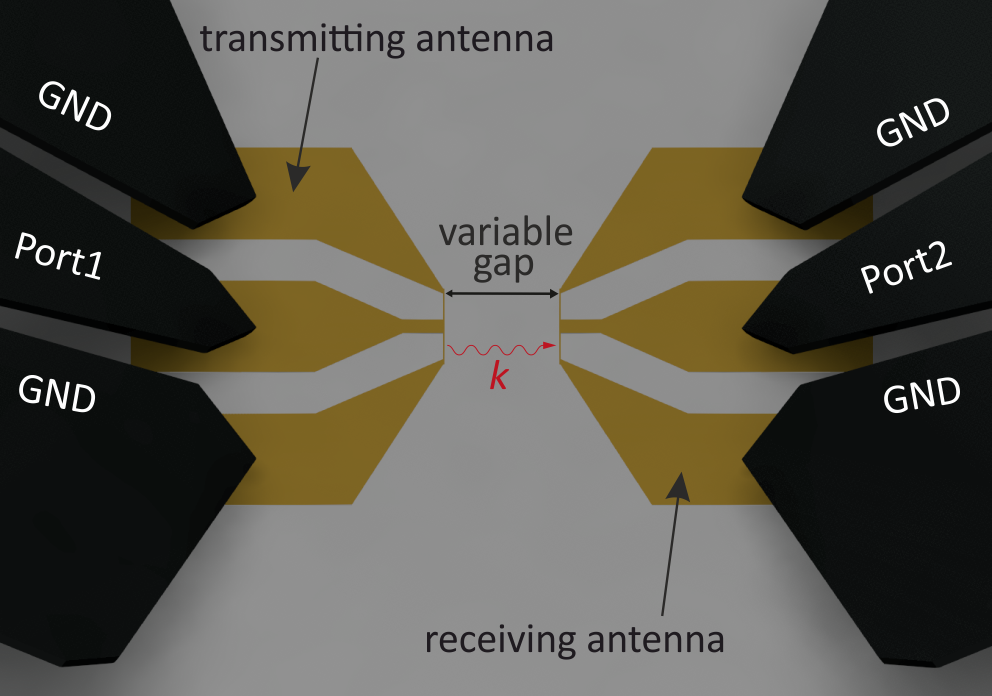
Propagating spin-wave spectroscopy (PSWS) is an electrical measurement technique used to characterize spin waves propagating between a pair of opposing microwave antennas. In our group, we have developed a variable-gap PSWS, which enables a direct measurement of the dispersion relation of spin waves based on the spin-wave phase difference with varied gap distance. It is a robust technique, delivering a fine frequency resolution results with small time consumption compared to phase-resolved µBLS or Kerr-effect-based techniques. The all-electrical nature of this technique makes it ideal also for low-temperature measurements, whereo optical techniques require much more expensive equipment.
Related publications:
- Vaňatka et al., Spin-wave dispersion measurement by variable-gap propagating spin-wave spectroscopy, Physical Review Applied 16, 054033 (2021). DOI: 10.1103/PhysRevApplied.16.054033
Corrugated waveguides
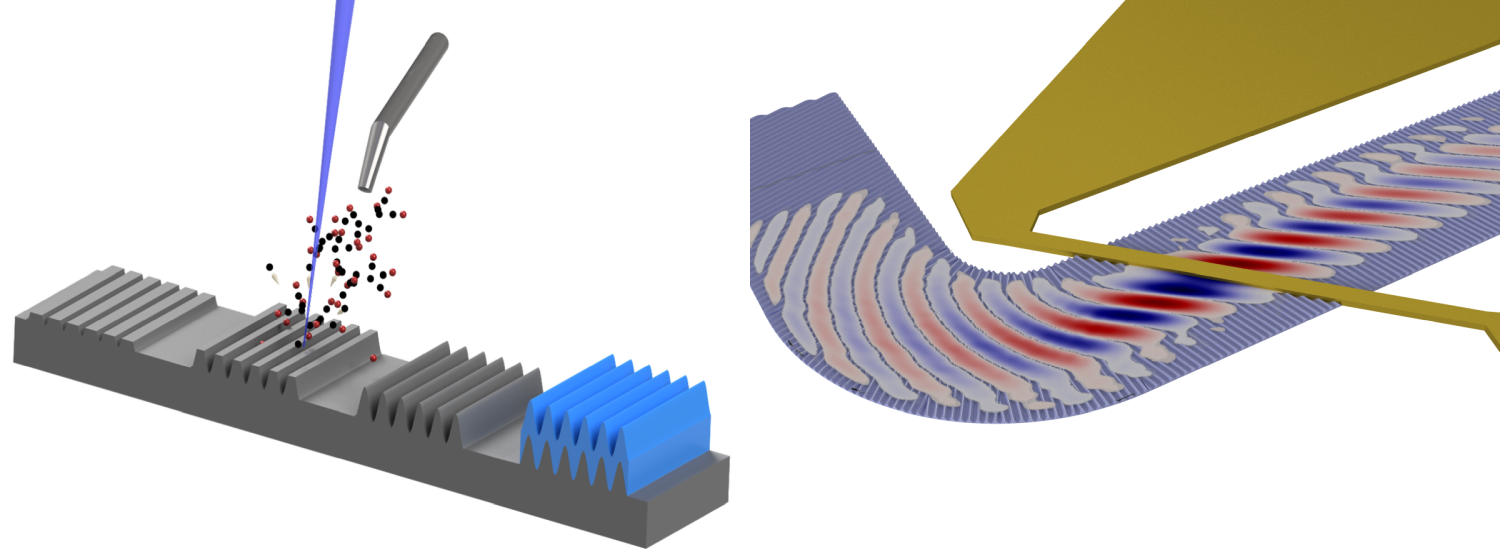
Focused electron beam-induced deposition (FEBID) allows fabrication of nanoscale 3D landscapes. We use this technique to fabricate waveguides with imprinted uniaxial anisotropy, allowing spin waves to propagate well without external field – this is important for integrated magnon circuits, where functioning in the absence of external field allows multidimensional spin-wave propagation. In such circuits, steering of spin waves is still a challenge. We have demonstrated that we can coherently steer spin waves in wide sharply-bent waveguides using the corrugation-induced anisotropy.
Related publications:
- Klíma et al., Zero-field spin wave turns, Applied Physics Letters 124, 112404 (2024). DOI: 10.1063/5.0189394
- Turčan et al., Spin wave propagation in corrugated waveguides, Applied Physics Letters 118, 092405 (2021). DOI: 10.1063/5.0041138
Older research topics
Magnetic vortices
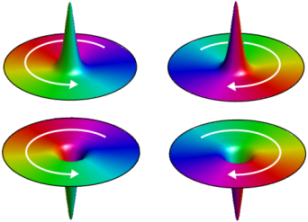
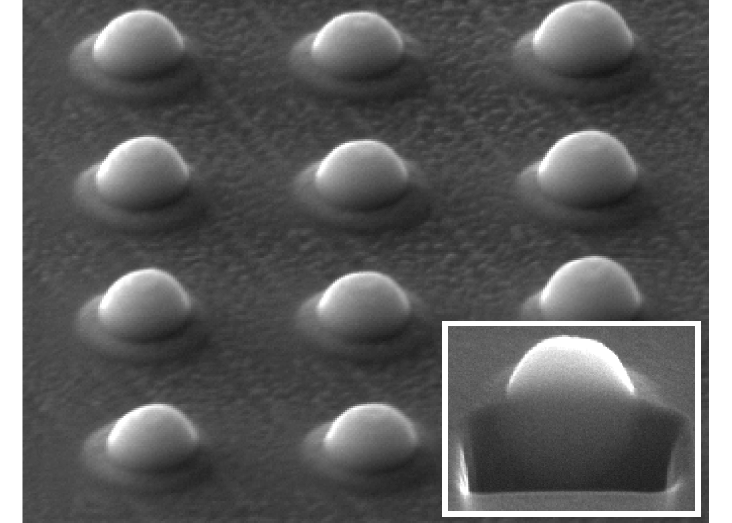
Magnetic vortices are curling magnetization structures formed in micro- and nanosized magnetic disks and polygons. They are known for having four different magnetization configurations (vortex states) that can be used for a multibit memory cell. We study dynamic magnetization processes of switching of the vortex states and we investigate the possibilities of writing two bits of information into a magnetic vortex. While most of the work has been done on planar structures, more recently we have been studying 3D vortices in micro- and nanosized spheres prepared by a combination of focused ion beam milling and electron beam induced deposition of Co (Co-C).
For further details, contact Michal Urbánek (michal.urbanek(at)ceitec.vutbr.cz).
Related publications:
- M. Vaňatka et al., Magnetic vortex nucleation modes in static magnetic fields, AIP Advances 7 (10), 105103 (2017). DOI: 10.1063/1.5006235
- Uhlíř et. al., Dynamic switching of the spin circulation in tapered magnetic nanodisks, Nature Nanotechnology 8, 341–346 (2013). DOI: 10.1038/nnano.2013.66